




FAQ
Definitions
-
What does the unit kilowatt-peak (kWp) mean?
Kilowatt-peak stands for the peak performance of a solar module under specified standard test conditions and serves as a neutral benchmark for performance evaluation.
Among the standard conditions (STC) are a cell temperature of 25° C and a solar irradiance of 1,000 watts per square metre. The temperature indication is particularly important because solar cells provide more power at lower temperatures and less at higher temperatures.
The peak performance is also referred to as "nominal power” or “rated power" by most manufacturers. Since the testing is executed under optimal conditions, the peak performance does not necessarily correspond to the peak performance under real irradiation conditions. Due to the irradiation-induced heating of the solar cells, the latter usually is about 15 to 20 percent below the STC values. However, due to weather-related factors, such as frost, performance can also be above peak performance.
-
How do you calculate the specific energy yield of a photovoltaic system?
As the annual energy yield is subject to many factors (module alignment, cell material, location, weather etc.), there is no simple answer to this question. However, as a guideline, the annual yield of an ideally oriented photovoltaic system in Central Europe, i. e. Germany, is approximately 850 to 1,100 kWh/kWp.
-
What is the MPP?
MPP is the abbreviation for Maximum Power Point. It describes the point of maximum power of a solar module where the product of current and voltage reaches its maximum. This point is not constant, but depends on the irradiation intensity, temperature and the type of solar cell.
-
What are strings?
A string is a series of solar modules connected in a row.
-
What is a cross connection?
The cross connection describes a two-ply rail frame for the assembly of modules. It consists of the lower carrier rail and the upper module rail. Whether it has to be used, depends on the design of the roof and the module orientation (vertical or horizontal).
-
What is a ballast-optimized system?
The ballast-optimized system is a mounting system for flat roofs with a roof inclination up to 5 °. The frame is placed on the roof and weighed by weights. The required weight mass is derived from pressure loads as well as the roof quality.
-
What is the azimuth angle?
In photovoltaics, the azimuth angle describes the deviation from the orientation to the south. A module, which directly points south, has an azimuth of 0°. For an east/west orientation, the azimuth is -90° (east) or +90° (west).
-
What is off-/on-grid?
An off-grid system is a stand-alone system which forms a closed-circuit without receiving electricity from or feeding electricity into the public network. On the other hand, an on-grid system is a photovoltaic system with a power generating solar generator which is connected to the public grid.
-
What is AC/DC?
The abbreviation "AC" stands for "alternating current". In contrast, “DC” is short for "direct current".
-
What is self-sufficiency?
In photovoltaics, the degree of self-sufficiency refers to the ratio between the self-used solar power of your photovoltaic system and the total electricity consumption. With a self-sufficiency degree of 100%, all consumed electricity was obtained from the own solar electric system.
The degree of self-sufficiency should not be confused with the self-consumption rate. This indicates the ratio between self-produced and self-consumed electricity.
-
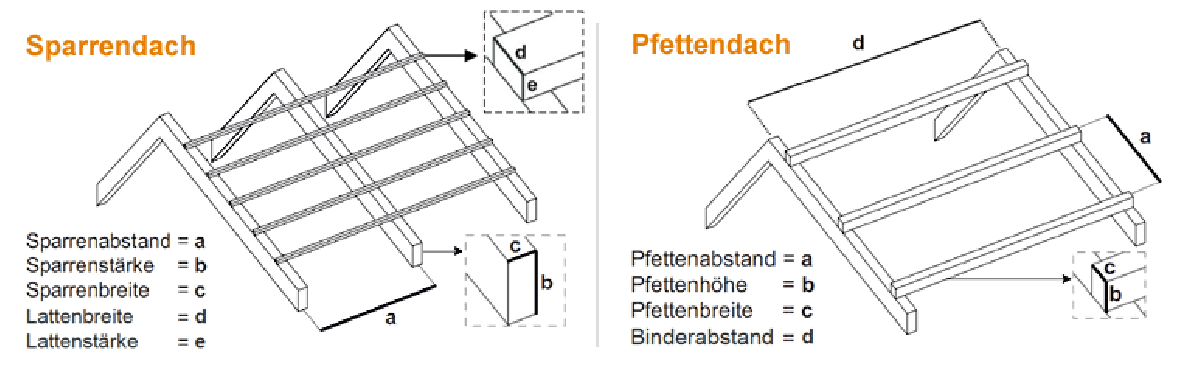
What is the difference between rafters and purlins?
Rafters run from roof ridge to eave and usually are more narrow-spaced than purlins which run from verge to verge. Tiled roofs often have a rafter construction, whereas trapezoidal sheet and corrugated eternit roofs often have a purlin construction.
-
What is the difference between kWh and kWp?
While kWh (= kilowatt-hours) is the unit of work, i. e. the product of power and time, kWp represents the module rated output in kilowatt-peak. These values are determined under standard test conditions (STC). The annual ratio of kWh and kWp is referred to as specific system yield.
-
What are mismatching losses?
The power flow of series-connected solar modules is limited by the weakest module. Accordingly, large performance tolerances affect the overall performance negatively, which is known as a mismatch loss. In order to minimize these losses (especially in the case of large performance tolerances), modules with similar performances should be installed in one string in order to achieve a better overall performance. The list of actual module performance (flash list) is helpful here.
-
What is smart grid?
Smart grids are intelligent power grids that combine generation, storage and consumption. A central control unit optimally coordinates all components and balances power fluctuations, particularly through renewable energies, in the network at the same time. The networking takes place through the use of information and communication technologies (ICT) as well as decentralized organized energy management systems for coordinating the individual components.
-
What is a performance ratio?
The performance ratio (PR) is a location-independent indicator for assessing the quality of a photovoltaic system. It is derived from the ratio between ideal and real yield and takes into account the combined losses of the entire system, including cables, meters and contacts. This value has a stronger influence on the economic profitability of a solar power plant than the location factors. Today's systems have a PR of 0.75 – 0.85.
-
What is a load profile?
Load profiles show the distribution of the annual average electricity load at certain times of the day, on weekdays, Saturdays and Sundays.
-
What is load management?
The term load management covers all (technical) measures that aim at consuming electricity when it is being produced by the PV system in order to increase your self-consumption. This can be achieved by using intelligent load management devices or by automatically switching on consumers (e. g. with the help of timers).